

Choosing the right battery for a BVLOS drone is not just about picking the highest capacity available. The battery has to match the drone’s range, payload, operating temperature, altitude and overall mission requirements. A drone battery for BVLOS drones should also be considered in terms of thermal management, OEM customisation and monitoring support. For manufacturers and operators, the right choice comes from understanding how all these factors work together during real-world delivery and long-range operations.
Start with the Actual Mission Profile
The first step is to understand what the drone is expected to do.
A delivery drone travelling a shorter route with a moderate payload will have very different battery needs from a BVLOS aircraft designed to cover longer distances or carry heavier loads. This is why battery selection should begin with mission requirements rather than only looking at voltage or capacity.
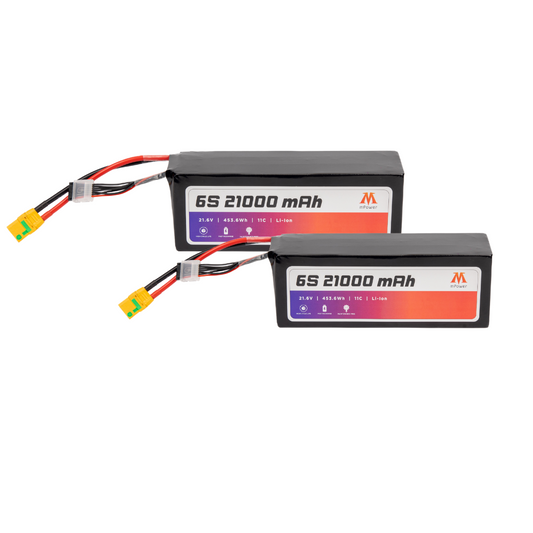
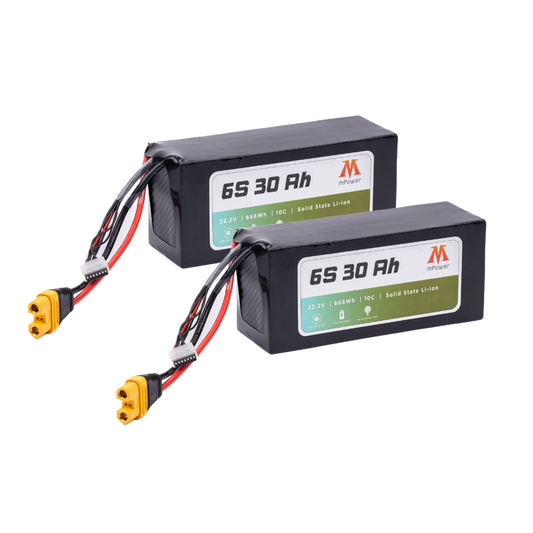
mPower’s lithium-ion batteries for delivery drones support ranges of up to 30 km and payloads of up to 50 kg. It also develops custom battery solutions for BVLOS delivery applications carrying payloads above 50 kg.
This shows why manufacturers need to define expected range and payload together before choosing the battery system.
Match Battery Performance to Payload Demands
Payload has a direct influence on how hard the drone needs to work during flight. As payload increases, the aircraft may need more energy to maintain lift and complete the planned route.
A drone battery for BVLOS drones should therefore be selected with the intended carrying capacity in mind.
mPower’s delivery-drone solutions are designed for commercial delivery applications and can be customised based on OEM specifications. This customisation is important because a battery that works well for one aircraft may not suit another platform with a different weight, payload or power requirement.
For heavier BVLOS applications, mPower specifically develops custom batteries for payloads above 50 kg.
Consider the Environment Before Finalising the Battery
Operating conditions can be just as important as range and payload.
Delivery drones may be used in locations where temperatures are low, altitudes are high or environmental conditions are demanding. In these situations, the battery system needs to be designed around the expected operating environment.
mPower’s delivery-drone batteries have been used in temperatures down to -60°C and trialled in the Ladakh-Leh region at around 18,000 ft MSL.
For manufacturers and operators working in such conditions, this highlights the importance of choosing a battery solution that has been developed with environmental demands in mind.
Thermal Management Should Not Be an Afterthought
Cold temperatures can create additional challenges for battery performance, which is why thermal management needs to be considered during battery selection.
These features are especially relevant when drones are expected to operate in very cold environments. Rather than treating thermal support as an optional extra after the drone is developed, it makes more sense to consider it as part of the battery design from the beginning.
This can help ensure that the battery configuration is suited to the mission environment.
Decide Whether Battery Monitoring Is Needed
Monitoring can become important when operators want better visibility into battery condition during more demanding missions.
mPower offers its Smart BMoS as an optional feature for delivery-drone batteries. A drone battery with BMoS can provide an additional layer of monitoring and management, which may be useful when drones are travelling longer distances or operating with heavier payloads.
For operators, this can support better awareness of battery behaviour during use.
For manufacturers, it also adds another factor to consider when designing the complete power system rather than looking only at the battery pack itself.
Look at the Level of OEM Customisation Available
BVLOS drones are often built for specific commercial purposes, so standard battery packs may not always be the best fit.
mPower’s battery solutions can be customised according to OEM specifications. This gives manufacturers the flexibility to develop a battery system around their aircraft requirements.
Customisation can be particularly useful when:
- The drone has a specific range target
- Payload requirements are higher
- Operating conditions are unusual
- The aircraft requires thermal-management support
- A drone battery with BMoS is needed as part of the system
This approach helps ensure that the battery is designed around the actual aircraft rather than forcing the drone to work around a fixed battery configuration.
Certification Requirements Should Be Part of the Selection Process
For commercial drone manufacturers, battery choice also needs to support the wider certification process.
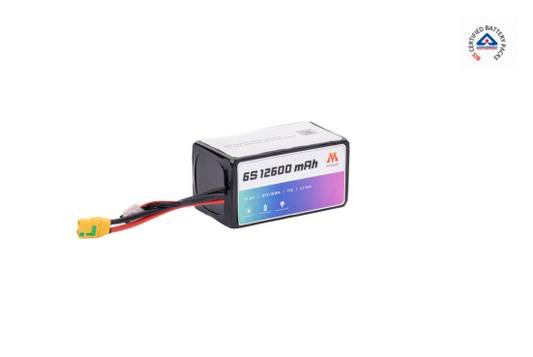
mPower states that it supports drone type certification using BIS-certified batteries.
This is an important consideration for OEMs because battery selection is not only a performance decision. It can also form part of the technical and certification requirements of the drone platform.
Manufacturers should therefore consider certification support while evaluating suppliers, rather than treating it as something to address later.
Compare the Battery as a Complete System
It is easy to compare batteries using a few basic specifications, but BVLOS operations usually require a broader view.
Before finalising a battery, manufacturers and operators should consider:
- Expected flight range
- Typical and maximum payload
- Operating temperature
- Operating altitude
- Thermal-management needs
- OEM customisation
- Monitoring requirements
- Certification support
Looking at these factors together gives a more realistic picture of whether the battery is suitable for the intended operation.
A drone battery for BVLOS drones should ultimately fit the aircraft, the mission and the environment rather than being selected based on a single specification.
Conclusion
Choosing a battery for BVLOS operations requires more than comparing capacity figures.
Range, payload, temperature, altitude, thermal management, customisation, monitoring and certification all influence whether a battery is suitable for the mission.
mPower’s delivery-drone battery solutions support delivery ranges of up to 30 km, payloads up to 50 kg, custom battery development for heavier BVLOS applications, low-temperature operation and thermal-management features such as heating strips and resin-based enclosures.
Where additional monitoring is required, a drone battery with BMS can also be included as part of the overall battery solution.
The most practical approach is to start with the drone’s real operating requirements and then choose a battery system that fits those conditions.
Discuss Your BVLOS Battery Requirements with mPower
mPower develops customised lithium-ion battery solutions for delivery and BVLOS drone platforms, including applications involving heavy payloads and demanding operating environments.
Connect with mPower to discuss a battery solution based on your drone’s range, payload, environmental conditions and OEM specifications.