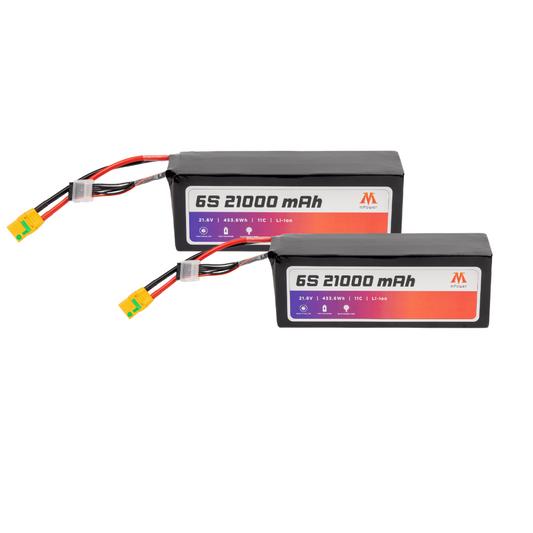
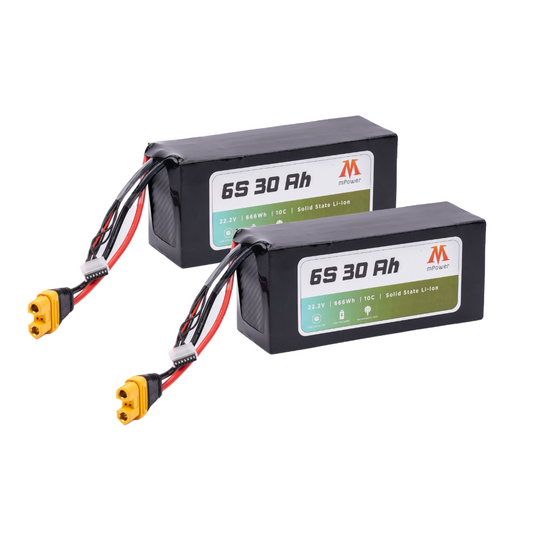
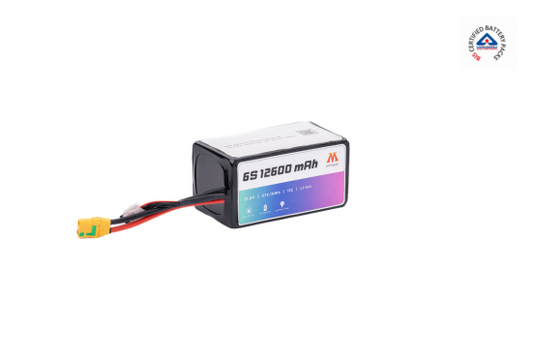
A 10L, 16L and 20L spraying drone may do the same job, but they do not place the same demand on the power system. As tank size increases, take off weight rises, motors draw more current and the battery must support a heavier aircraft without becoming so large that it reduces useful payload.
The right agri drone battery for a 10L platform must prioritise low weight and efficient energy use, while 16L and 20L drones need stronger power delivery, greater usable energy and better thermal control.
10L Drones Need a Lightweight Power System
For a 10L spraying drone, battery weight matters because the aircraft has less room to absorb unnecessary mass. An oversized pack may increase stored energy, but it also raises the load the motors must carry throughout the flight, which can reduce the practical endurance benefit.
Battery design for this class should therefore focus on energy density, discharge capability and pack weight. Capacity and voltage need to be matched to the drone’s motor configuration, ESC ratings, maximum take-off weight and intended spraying cycle rather than assuming that every 10L platform needs the same battery specification.
The agriculture drone battery should provide enough usable energy and current for full-payload operation without compromising the lighter, more efficient characteristics that make a 10L platform practical.
16L Drones Need More Balance Between Energy and Weight
A 16L drone carries more liquid, so the battery has to support higher thrust for longer while remaining light enough to preserve the benefit of the larger tank. Simply adding capacity is not enough because every additional gram becomes part of the load.
This class needs a stronger balance of energy, voltage stability and continuous discharge capability. The agricultural drone battery must cope with full tank take off, turns and altitude corrections without excessive voltage sag.
Compared with a 10L platform, a 16L drone generally places greater demand on sustained current delivery. That means the battery has to maintain stable output while still keeping overall pack weight under control.
20L Drones Put More Pressure on Power Delivery
At 20L, the engineering challenge changes again. The drone must lift a larger liquid load, and the motors may need high current for longer during take off and flight.
Voltage and discharge capability become more important because higher voltage systems can deliver the same power at lower current. That can reduce electrical losses and heat in wiring, connectors and power electronics.
A 20L agri drone battery therefore has to be engineered as part of the propulsion system, not selected by tank size alone. Capacity, voltage, discharge capability and thermal behaviour all need to work together under a heavier operating load.
Similar Capacity Does Not Mean Similar Performance
Two batteries with similar Ah ratings can behave differently if their voltage, weight, chemistry or discharge characteristics differ. Capacity alone is therefore a poor way to compare power systems for 10L, 16L and 20L drones.
A smaller aircraft may benefit more from reduced battery mass, while a larger platform may need additional energy and voltage to support the heavier load. The agriculture drone battery must be matched to motor and ESC requirements as well as expected current draw.
Frame design, motor efficiency and maximum take off weight can also change the requirement, even between drones with the same tank size. This is why battery selection has to begin with the complete aircraft specification.
Charging Strategy Changes as Drone Size Increases
Battery design affects what happens between flights as much as what happens in the air. Larger packs store more energy and can require more capable chargers, cooling and a planned battery rotation strategy.
A 10L operation may work efficiently with several lighter packs, while a 20L platform may need higher power charging and closer attention to battery temperature. Fast charging helps only when the cells, BMS, charger and thermal design support it safely.
This matters when comparing the best drones for agriculture spraying because productivity is measured across a working day. A larger tank offers less advantage if charging or cooling leaves the aircraft waiting on the ground.
Thermal Behaviour Becomes More Important With Higher Loads
As current demand increases, so does heat generation. Repeated spraying cycles can place significant thermal stress on the battery, particularly when flights are closely spaced throughout the day.
A battery that performs well during the first sortie may not remain equally efficient if heat builds up over several cycles. Larger 16L and 20L platforms therefore benefit from battery designs that manage temperature effectively and maintain predictable output during repeated use.
Thermal behaviour also influences charging turnaround. If a pack requires a long cooling period before it can be charged safely, daily productivity can fall even when individual flight performance appears strong.
Smart Battery Management Becomes More Valuable
As battery energy and payload increase, monitoring becomes more useful. State of Charge, cell voltage and temperature can help operators judge whether a pack is ready for another mission.
For larger commercial platforms, the right agricultural drone battery can improve predictability. Smart monitoring helps when several packs rotate between flight, cooling and charging, especially during intensive spraying schedules.
Battery management can also help operators identify changes in pack behaviour over time. That becomes important when consistent flight performance matters across an entire spraying season.
Conclusion: Tank Size Should Change the Battery Design
The difference between 10L, 16L and 20L agricultural drones is not simply how much liquid they carry. Each step up changes aircraft weight, motor demand, current draw, heat generation and the energy needed to complete a useful sortie.
A 10L drone generally benefits from a lighter pack, a 16L platform needs a balance of energy and discharge capability. 20L drone places greater emphasis on sustained power, voltage efficiency and thermal control. These differences matter when evaluating the best drones for agriculture spraying or designing a new platform.
mPower offers lithium ion and solid state battery solutions across multiple capacities and 6S and 12S configurations for agricultural applications. Matching the battery to payload, voltage and propulsion requirements helps ensure the power system supports the aircraft rather than limiting it.
Choose a Battery Built Around Your Drone’s Actual Load
A spraying drone performs best when its battery is matched to the aircraft rather than selected as a standard replacement part. Tank size, propulsion setup, voltage, payload and daily operating pattern should all influence the final battery configuration.
mPower works with agricultural drone requirements across different capacities and power architectures. Explore the available battery options or speak with the mPower team about a configuration designed around your 10L, 16L or 20L drone platform.