

Drone power systems influence flight time, payload support, safety and overall reliability. Choosing the right pack requires more than comparing capacity. Voltage, cell configuration, discharge rate, chemistry, dimensions, connector type, weight and charger compatibility all matter. A suitable drone battery should match the aircraft manufacturer’s requirements and the conditions in which the drone will operate. This guide explains the main specifications, selection factors and care practices that help operators make informed decisions.
What the Battery Must Support
A battery does more than supply electricity. It must provide the correct voltage, deliver enough current when demand rises and fit securely within the aircraft.
Different applications create different power needs. A pack designed for one use should not automatically be transferred to another.
mPower Lithium recommends evaluating the complete aircraft, including its motors, electronics, payload, mounting space and operating requirements.
Understand the Main Specifications
Battery specifications should be reviewed together. Looking at only one figure can lead to poor compatibility.
Voltage and Series Configuration
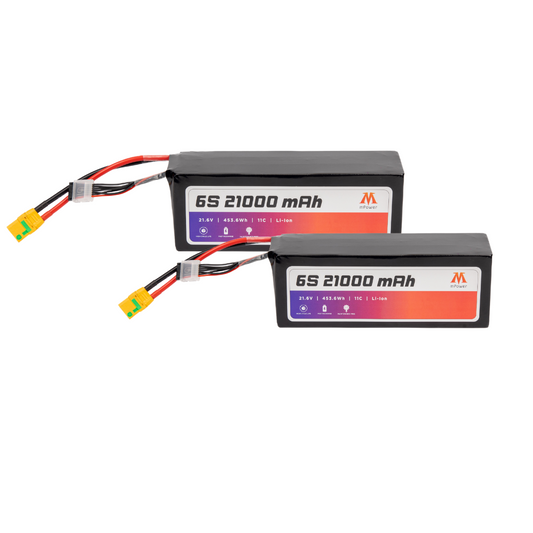
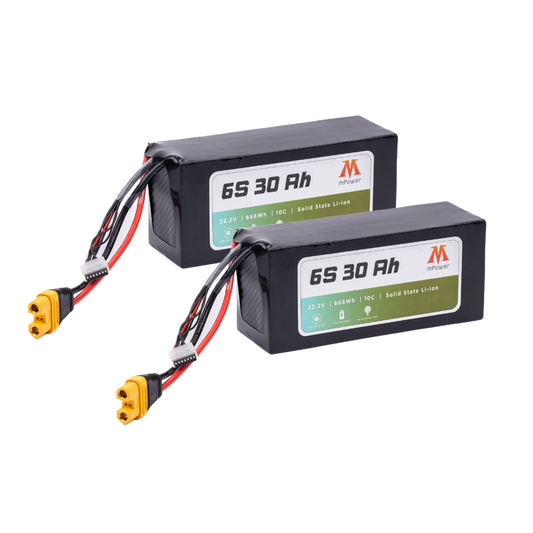
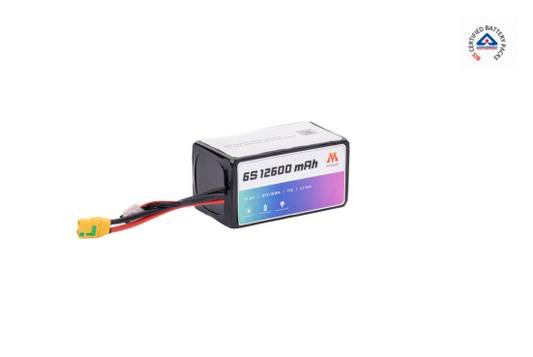
Voltage must match the aircraft’s electrical system. mPower’s catalogue includes 3S, 4S, 6S, 12S and 14S configurations, along with several nominal voltage options.
The series configuration must also match the motors, electronics and charger.
Capacity
Capacity indicates how much energy the pack can store. A higher figure may appear to promise longer use, but it can also increase size and weight.
Extra weight can raise motor demand and reduce flight efficiency. The largest pack is therefore not always the most suitable one.
Discharge Rate
The discharge rate shows how much current the pack can provide relative to its capacity.
Take-off, climbing, hovering and carrying a payload can create changing power demands. Selected drone batteries must support these loads without being operated beyond their intended limits.
A pack with insufficient discharge capability may not suit a heavier aircraft. At the same time, a higher rating should not be chosen unless the platform actually requires it.
Choose the Appropriate Chemistry
mPower works with lithium-ion, lithium-polymer and solid-state technologies. It also develops customised solutions for OEM and enterprise applications.
Each chemistry should be assessed according to the aircraft rather than treated as universally better. Important factors include
- Required discharge performance
- Available mounting space
- Maximum permitted weight
- Charger compatibility
- Operating conditions
- Application and payload
Lithium-ion, LiPo and solid-state options are not interchangeable simply because they are all used in drones. The final choice should reflect the system design and intended use.
Check Size, Weight and Fit
Electrical compatibility alone is not enough. The pack must fit the available mounting area and remain secure throughout the flight.
Before selecting a pack, confirm
- Length, width and height
- Total weight
- Connector position
- Cable length
- Connector type and polarity
- Mounting orientation
A poor fit can strain wires or interfere with the frame, sensors or payload.
Weight deserves special attention. A heavier drone battery may store more energy, but the aircraft must also use more power to carry it. Capacity should therefore be balanced with total take-off weight.
Use the Correct Charger
The charger must match the battery chemistry, voltage and charging requirements. Fast charging should only be used when both the charger and pack are designed to support it.
mPower advises allowing a hot pack to cool before charging. It mentions a 40-minute cooling interval between charging cycles. Operators should still follow the instructions supplied with the specific product and charger.
For repeated operations, rotating compatible packs can make charging and cooling easier to manage.
Inspect Before and After Use
Regular inspection should be part of every flight routine. This is especially important when packs are handled often or used in demanding conditions.
Check for
- Swelling or leakage
- Damaged wiring
- Loose connectors
- Impact marks
- Reduced capacity
- Unusually rapid discharge
A damaged pack should be removed from service and professionally assessed. Terminals should be protected from contact with metal objects.
Where appropriate, protective battery bags or fire-safe containers may be used during charging, storage or transport.
Store and Transport Safely
For longer storage, mPower recommends keeping batteries at the correct storage voltage in a cool, dry environment.
Packs should be labelled so charged, discharged and damaged units do not become mixed. They should also be protected from being dropped, crushed or exposed to moisture.
Airline rules for lithium battery transport can vary, so operators should confirm them before travelling.
When Custom Development Makes Sense
Standard products can suit many aircraft, but some platforms have unusual electrical or physical requirements.
A custom solution may be useful when the drone needs a specific
- Voltage or capacity
- Chemistry
- Connector
- Discharge rate
- Shape or dimensions
- Weight
mPower develops customised solutions based on the complete application. A custom pack should not be designed around capacity alone. The aircraft’s electrical system, payload, mounting arrangement and charger must all be considered.
Questions to Ask Before Buying
Before choosing drone batteries, ask
- What voltage and series configuration are recommended?
- What is the maximum permitted battery weight?
- Which capacity range suits the payload?
- What discharge demand does the aircraft create?
- Does the connector and polarity match?
- Will the pack fit securely?
- Is the charger compatible?
- Are multiple packs needed for rotation?
- What storage and transport process will be followed?
- Is a standard product suitable, or is customisation required?
These questions help prevent decisions based only on price or capacity.
Conclusion
A reliable power setup begins with proper compatibility. Voltage, series configuration, capacity, discharge rate, chemistry, size, weight, connector and charger must work together.
The best choice is not automatically the pack with the highest capacity. It is the option that fits the aircraft, supports the payload and can be charged, cooled, stored and inspected safely.
Careful selection and maintenance help the power system perform consistently across everyday and specialised operations.
Not sure which battery fits your drone? Share your requirements with mPower Lithium and get help choosing the right option.