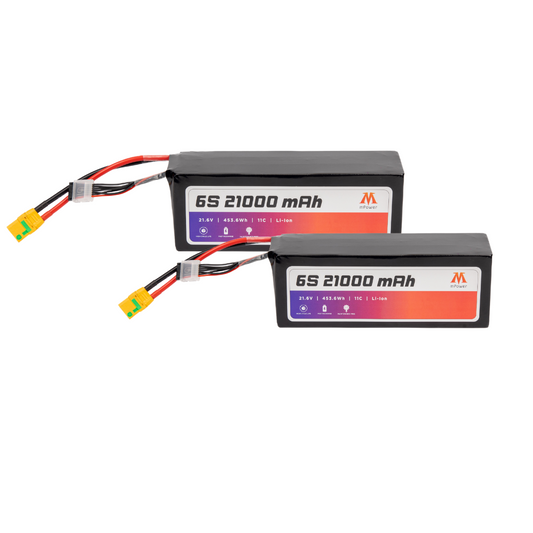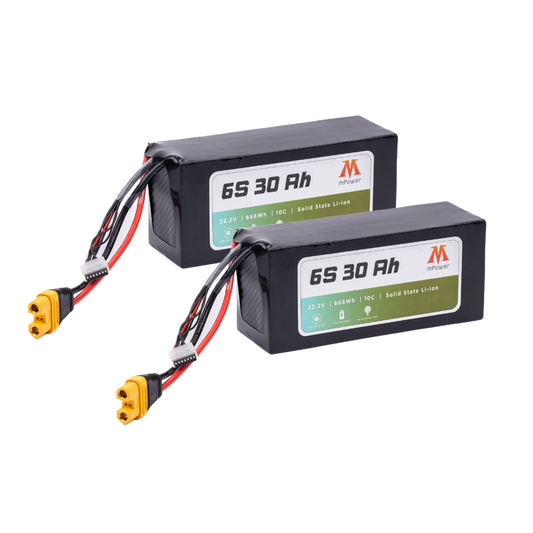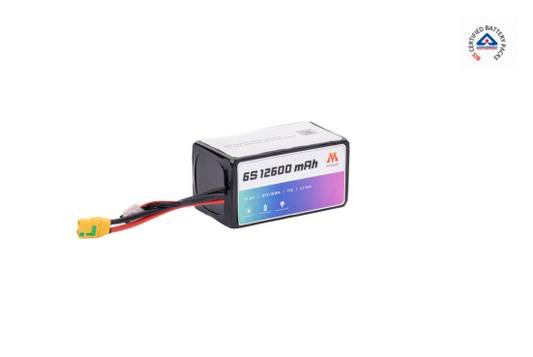


Drone battery selection for medical transport drones should begin with payload weight, route distance, voltage requirement, discharge support, connector compatibility, charging safety and long term reliability. Medical transport works like a focused delivery drone application, where the aircraft may carry sensitive payloads across planned routes. The right choice is not only about longer flight time. It is about whether the battery can support the mission safely, repeatedly and without sudden performance loss.
Why Battery Choice Matters in Medical Transport
A medical transport drone may be used to move small but important payloads between locations. That means the drone needs steady lift, controlled movement and dependable energy from take off to landing. If the battery output drops during the route, the mission can become unreliable.
mPower builds battery solutions for professional UAV applications such as delivery, agriculture, surveillance, surveying, mapping and robotics. The same selection logic applies here because the battery affects flight time, payload support, safety, uptime and operating cost.
Start with Payload and Route Planning
Before selecting a battery, understand what the drone must carry and how far it must travel.
Ask these questions first
- What is the total payload weight?
- What is the one way and return distance?
- Will the drone fly in heat, wind, dust, or humidity?
- How many trips are expected in one day?
- Is quick turnaround needed between flights?
A delivery style drone needs balance. If the battery is too small, the drone may not complete the route with enough safety margin. If it is too heavy, flight efficiency can reduce. This is why mPower focuses on application specific solutions instead of generic packs.
Check Voltage, Capacity and Discharge Rate
Every UAV platform has its own electrical requirement. Choosing the wrong voltage or capacity can affect performance, fitment and safety. mPower highlights voltage, capacity, discharge rate, connector compatibility, weight and charging requirement as key factors when selecting a power solution.
For medical transport drones, capacity supports flight duration. Voltage supports the drone’s power system. Discharge rate matters during take-off, climb, route changes and landing. A good drone battery should not only deliver power at the start. It should keep supporting motors, controllers and payload movement through the complete flight plan.
Choose Chemistry Based on the Application
mPower offers lithium-ion batteries, solid-state batteries and custom battery packs for professional UAV needs. Each mission may need a different balance of endurance, weight, discharge support and safety.
Lithium-ion options are valued for dependable energy delivery and practical operation. Solid-state battery options are part of mPower’s advanced portfolio and are used across delivery focused products. For medical transport, the right chemistry should be selected after reviewing platform design, payload, range expectation and charging cycle.
Give Weight the Attention It Deserves
Weight has a direct impact on drone performance. A battery must provide enough energy without making the aircraft inefficient. mPower’s positioning includes compact designs, reduced weight and improved performance because professional UAVs depend on this balance.
For medical transport, extra battery weight can reduce useful payload capacity or shorten flight efficiency. At the same time, a pack that is too light may not provide enough capacity for the mission. The better approach is to match the drone battery to the actual platform and operating goal.
mPower supports custom battery development and bulk corporate orders for drone manufacturers, enterprises, RPTOs and UAV operators.
Look for Stable Power, Not Just High Capacity
A high-capacity pack may look attractive, but medical transport drones need stable output more than impressive numbers. The battery should support steady performance during take-off, route movement, landing and repeated use.
mPower’s application based approach makes this clear. Survey and mapping drones need stable power output to complete planned missions. Delivery drones need a balance of payload support and travel distance. Medical transport drones fall into a similar category, where reliable energy matters throughout the journey.
This is why drone batteries must be judged on fitment, charging safety, workload support and consistent performance.
Consider Safety, Certification and BMoS Support
For commercial drone use, safety cannot be treated as an afterthought. mPower focuses on BIS-certified options, quality checks, Made-in-India manufacturing and batteries suited for professional operations.
A medical transport operator should look for
- BIS-certified battery options where applicable
- Reliable manufacturing quality
- Proper charging support
- Battery management protection
- Safe fitment with the drone platform
- Consistent performance in real conditions
mPower battery packs use a tuned battery management system that monitors charging cycles, temperature and cell balance. This helps protect the battery and supports predictable performance.
Plan Charging and Daily Rotation
Medical transport drones may need repeated trips in a day. Battery planning should include charging time, charger compatibility, rotation strategy and backup packs. mPower highlights fast charging, safe charging and charging requirements as important parts of battery selection.
Operators should calculate how many drone batteries are needed for the expected workload. A proper rotation plan reduces waiting time, avoids deep discharge and helps maintain battery life.
Work with a Battery Partner
Medical transport drones need reliable support, correct configuration and technical understanding. mPower serves drone OEMs, users, RPTOs and supports custom battery development for specific needs.
For fleet operations, mPower’s Corporate Partnership Program can support high-volume needs with better pricing, warranty, access to R&D, recycling support, aftermarket sales and order fulfilment.
Conclusion
Selecting the right medical transport drone battery is about matching the battery to the aircraft, mission profile, and operating environment. The right balance of voltage, capacity, weight, discharge capability, and battery management improves safety, efficiency, and long term operational reliability.
A well matched power solution helps the drone fly safely, carry its load efficiently and complete repeated missions with fewer interruptions. mPower builds specialised lithium-ion, solid-state and custom battery solutions for professional UAV applications, including delivery style operations.
Looking for high performance drone batteries for delivery or specialised UAV applications?
Connect with mPower Lithium for BIS certified options and expert support built around your drone platform.