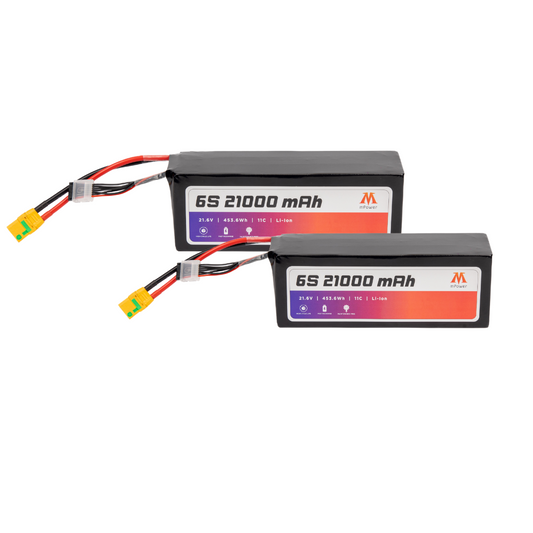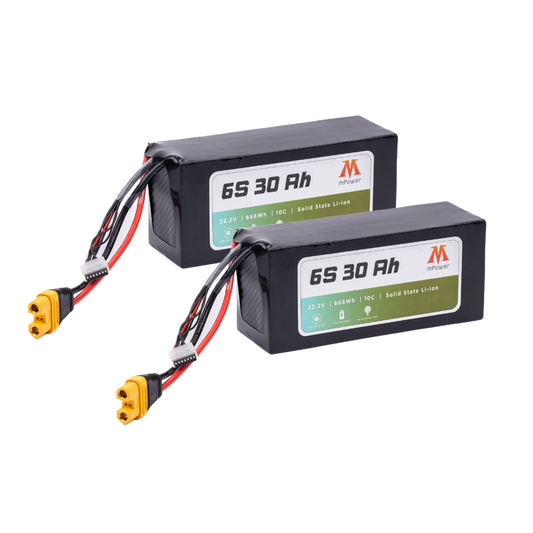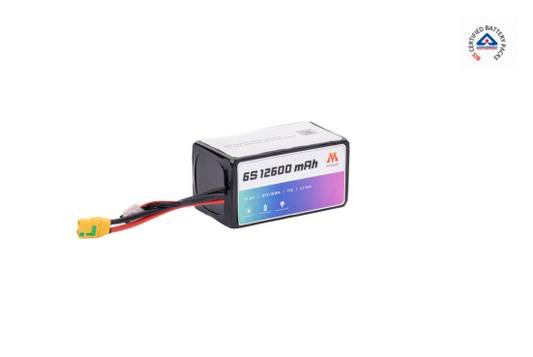


BVLOS operations place greater demands on a battery because the drone may travel farther, carry heavier payloads and operate in conditions where dependable power matters throughout the mission. A drone battery for BVLOS drones therefore needs to be evaluated for more than capacity. Range support, payload capability, environmental tolerance, thermal management, battery monitoring and OEM-level customisation all matter.
BVLOS Missions Need More Than Standard Battery Capacity
Beyond Visual Line of Sight operations involve longer and more demanding flight profiles. Delivery drones may need to travel significant distances, carry useful loads and maintain dependable battery performance across changing conditions.
mPower’s lithium-ion batteries for delivery drones support delivery ranges of up to 30 km and payloads of up to 50 kg. It also develops custom batteries for BVLOS delivery applications carrying payloads above 50 kg.
That makes battery selection a system-level decision. The battery needs to match the drone's weight, expected range, payload and operating environment rather than being selected only by its stated capacity.
Range and Payload Need to Be Considered Together
Longer routes place sustained demand on the battery, while heavier payloads can increase the energy required during flight. A drone battery for BVLOS drones should therefore be matched to the intended mission profile.
mPower's delivery-drones support for ranges up to 30 km and payloads up to 50 kg. For heavier BVLOS applications, the company develops customised batteries according to OEM requirements.
This matters because delivery drones are not all built to the same specifications. Battery requirements can change with aircraft size, payload, route and operating conditions.
Environmental Conditions Can Change Battery Requirements
Distance and payload are only part of the challenge. BVLOS drones may also operate in environments that place additional stress on the battery.
mPower’s delivery-drone batteries have been used in temperatures down to -60°C and trialled in the Ladakh-Leh region at approximately 18,000 ft MSL.
To support operation in demanding cold conditions, mPower uses thermal-management solutions including heating strips and resin-based enclosures.
Thermal Management Becomes Part of Mission Planning
A battery needs the right operating conditions to perform as intended. In very cold or high-altitude environments, thermal management becomes an important part of the battery design.
For BVLOS missions, this is particularly relevant because the aircraft can be operating farther from the pilot. The battery system therefore needs to be selected with the expected environment in mind before the drone is deployed.
Battery Monitoring Adds Useful Visibility
mPower offers its BMoS (Battery Monitoring System) as an optional feature for delivery-drone batteries.
A drone battery with BMoS adds another layer of battery monitoring and management, which can be useful for longer or more demanding missions. It gives operators additional insight into battery condition instead of relying only on basic charge information.
For BVLOS operations, that visibility can support more informed battery management when the aircraft is travelling farther or carrying heavier loads.
Why OEM Customisation Matters
There is no single battery configuration that suits every delivery drone.
mPower’s batteries can be customised according to OEM specifications. This allows battery development to account for the aircraft's specific requirements rather than forcing every platform to work around a standard pack.
Customisation is especially relevant for applications involving longer routes, heavier payloads or demanding environments. mPower also develops custom batteries for BVLOS delivery applications with payloads above 50 kg.
Certification Support Also Deserves Attention
For commercial drone manufacturers, battery selection needs to fit into the wider certification process.
mPower supports type certification using BIS-certified batteries. This is relevant for OEMs developing drones for commercial applications and looking for battery solutions that align with their certification requirements.
Battery choice therefore involves more than matching voltage or capacity. Technical fit, customisation and certification support all need consideration.
A Practical Checklist Before Selecting the Battery
Manufacturers and operators should begin with the mission rather than a single battery specification. Key questions include:
- What range must the drone cover?
- What payload will it carry?
- Will it operate in very cold or high-altitude conditions?
- Does the battery need thermal-management support?
- Is an OEM-specific battery configuration required?
- Would a drone battery with BMoS provide useful monitoring for the operation?
These questions connect battery capability with the real demands of the aircraft.
Reliable BVLOS Operations Depend on Battery Fit
A reliable battery cannot be judged by one number alone. Range, payload, environment, thermal management, monitoring and customisation need to work together.
A lighter delivery drone operating in moderate conditions will not have the same battery needs as a platform carrying more than 50 kg in a cold, high-altitude environment. That is why battery selection should begin with the actual mission profile.
Where additional battery visibility is required, a drone battery with BMS can also become part of the overall operating strategy.
Conclusion
BVLOS drone operations require a battery system aligned with the aircraft's range, payload, temperature, altitude and mission profile. Thermal management can be important in demanding environments, while OEM customisation helps match the battery to the platform.
mPower's delivery-drone solutions support ranges up to 30 km, payloads up to 50 kg, customised solutions for heavier BVLOS applications, low-temperature operation, thermal-management features and optional BMoS.
The key for manufacturers and operators is to evaluate the battery as part of the complete drone system, not as a standalone power pack.
Connect with mPower to explore a customised battery solution built for your BVLOS drone’s range, payload and operating requirements.